
Many traders mistakenly believe that the best moment to enter a trend is at its very beginning. In practice, however, the most reliable trades often occur not at the start, but slightly later — when the movement has already proven its strength by making its first impulse, and then provides a brief respite in the form of a correction.
It is precisely at this moment, when the market “catches its breath,” that a high-probability entry point forms. The “Impulse Pullback” methodology focuses on such phases: it does not chase the initial surge, but waits for the trend to reveal its character — and only then joins it.
The strategy is based on a simple yet powerful idea: a sustainable trend rarely moves in a straight line. It moves in waves — impulse, pullback, impulse. And the second impulse is typically stronger and more predictable than the first, because it is already backed by confirmed expectations of market participants.
The key point is that the strategy described below uses only two indicators to identify such moments: the EMA with a period of 50 — as a direction filter, and the RSI with a period of 9 — as a measure of the correction phase. Both tools are available in the list of built-in advisors on the CloseOption platform.
How to Identify a Suitable Situation
First, assess the overall position of the price relative to the moving average on the M5 or M15 timeframe. If the line has a clear upward slope and the price holds above it — an upward context is forming. If the slope is downward and the price is below — a downward context. This information alone is not yet a signal, but it sets the direction in which trades will be sought.
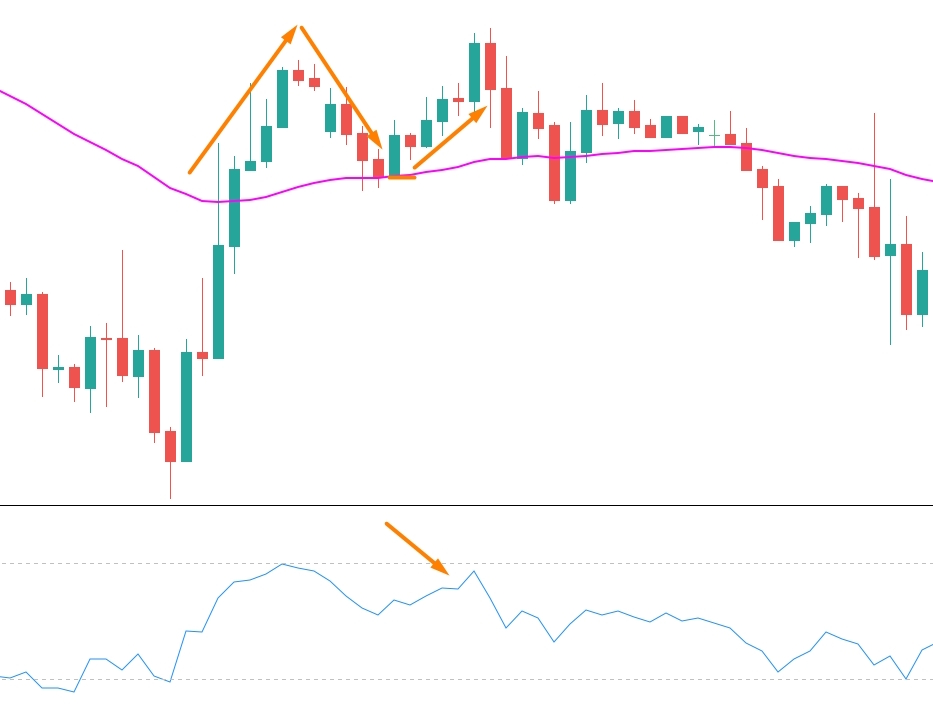
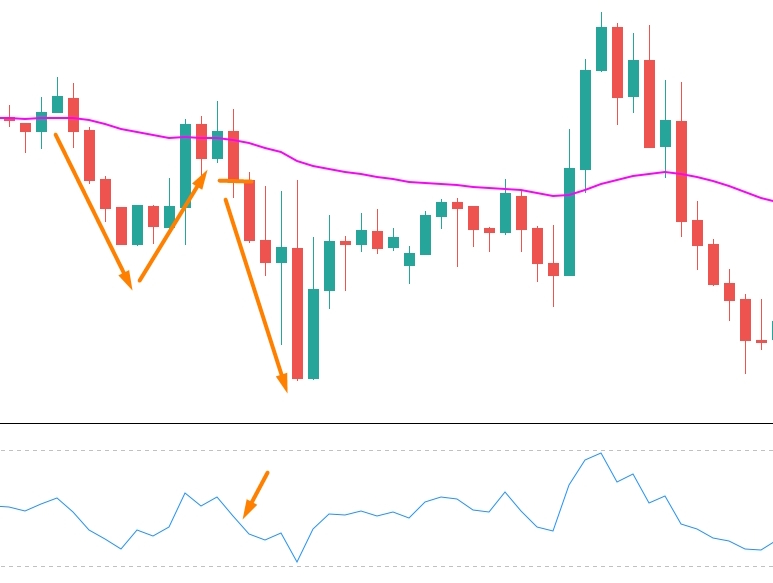
Next, identify the phase: over the past 20–30 minutes, there should be a pronounced impulse — a series of 3–5 candles moving in one direction with minimal counter-movements. This should be followed by a correction — the price returns toward the EMA(50), but does not break through it. An ideal pullback lasts 3–6 candles, occurs with decreasing volatility, and does not disrupt the overall slope of the moving average.
Signal Formation and Confirmation
The key moment is the behavior of the RSI(9) during the pullback phase.
For an uptrend: The line descends but does not dive deeply into the oversold zone — it stops around 40–45, then turns upward, crossing its previous local minimum on the oscillator chart. This is a sign that buyer pressure remains strong and that the correction was technical rather than fundamental.
For a downtrend: The RSI rises to 55–60, but does not reach 70, and then turns downward, forming a lower peak on the oscillator itself. This indicates that bearish control is maintained.
Once the RSI gives a reversal signal and the price begins to move away from the EMA in the direction of the main trend, an entry is formed:
- Pullback to EMA(50) upward + RSI reversal upward = CALL
- Pullback to EMA(50) downward + RSI reversal downward = PUT
Important: Entry is executed not exactly at the EMA, but on the first candle confirming the resumption of movement — i.e., a candle that closes farther from the moving average than the previous one.
Expiry time: 15–25 minutes, which corresponds to the standard duration of the second impulse.
Advantages and Limitations
The main advantage of “Impulse Pullback” is the high probability with relatively low risk. Since entry occurs after a confirmed impulse and within an already-formed trend, the chances of the movement continuing are significantly higher than when trying to guess a reversal or catch the first surge.
Additionally, the strategy excludes trading in flat markets: if the EMA(50) is horizontal or the price constantly crosses it back and forth, signals are not generated.
The strategy also works excellently with a measured trading style: on average, 2–4 suitable situations arise per session, each requiring minimal time for analysis. This reduces fatigue and helps maintain discipline.
However, the strategy has clear limitations:
- It is not suitable for very short expirations, as it requires time for the pullback to form and for confirmation.
- If, during a correction, the price closes on the opposite side of the moving average, the trend is considered broken, and further entry attempts are prohibited until a new structure forms.
- During periods of extreme volatility (e.g., during news releases), the RSI may give false reversal signals, so such moments are best skipped.
The methodology is especially effective on assets with pronounced trending behavior — such as GBP/USD, USD/JPY, as well as cryptocurrencies during phases of sustained movement. The optimal trading time is the middle of the European session and the first half of the American session, when liquidity is stable and major players have already determined the day’s direction.
Conclusion
In summary, “Impulse Pullback” is a strategy for those who understand: it is not always the one who runs first who reaches the goal. Sometimes it is more profitable to wait a little, confirm the strength of the movement — and only then take a confident step.